

How to build psychological safety in your team
Psychological safety of staff has a major impact on the culture of an organization. It affects individual and team performance, productivity, staff retention and the environment of a workplace. Nowadays, we are all familiar with the concept that maintaining good mental health is important, but what do buzzwords and phrases like ‘psychological safety’ and ‘radical candor’ actually mean in practical terms?
Psychological safety and radical candor
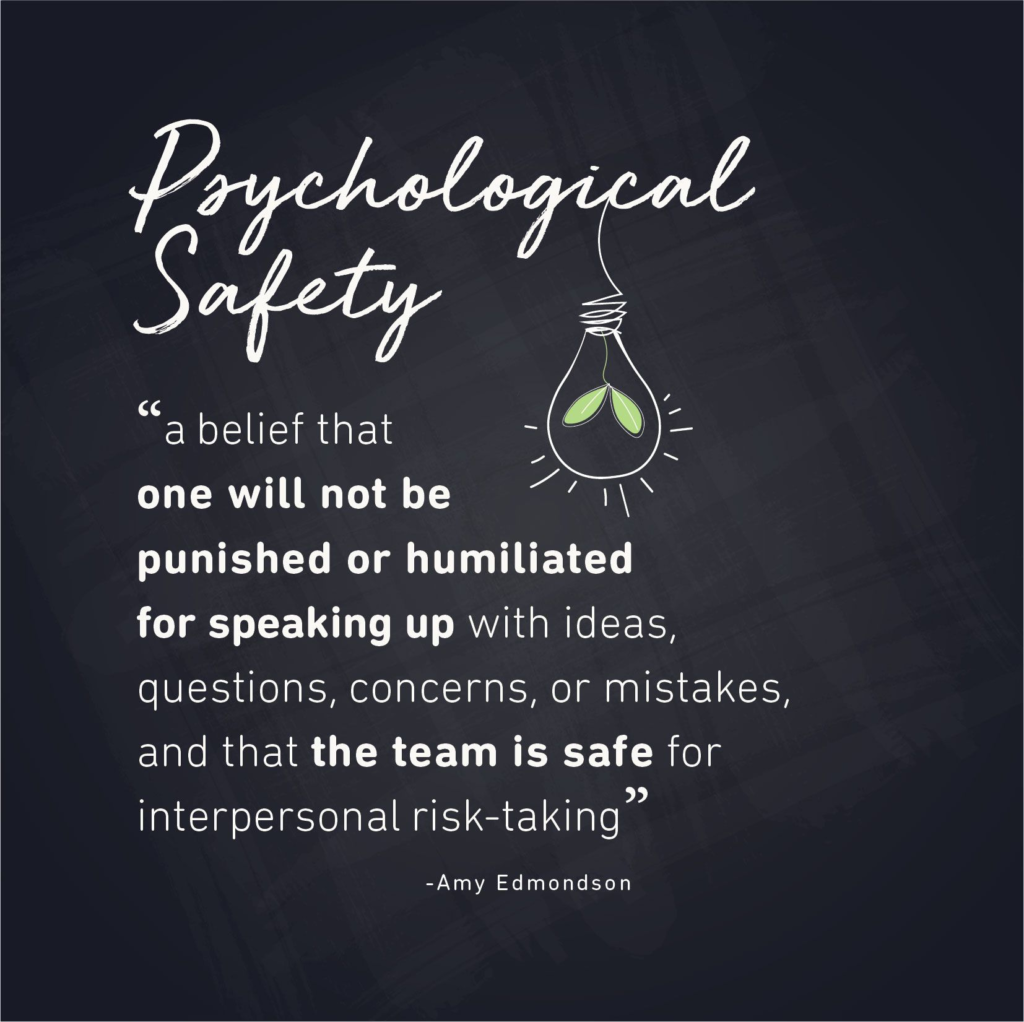
Psychological safety refers to individuals feeling comfortable expressing themselves and their ideas without fear of judgement. A workplace succeeding at this should have a team of people who feel able to make mistakes, provide constructive criticism to their counterparts and test out new approaches to tasks. It doesn’t necessarily mean everyone is comfortable all the time, it’s also about being confident to feel discomfort, for example when receiving criticism about yourself.
Radical candor is a feedback approach that combines both caring personally and challenging directly. When leaders use this, they honestly communicate whilst respecting the other person’s feelings. It is being direct but leading with empathy, to ensure clarity on issues raised without speaking negatively of someone’s character. Psychological safety provides a foundation for radical candor to be possible, and radical candor strengthens psychological safety.
Evidence shows that psychological safety improves team performance. Organizations who are supporting this notion not only have happier team members but quantifiable results such as revenue streams also increase. Prioritizing psychological safety benefits both employers and employees.
Radical candor graph
David’s thoughts...
We asked one of Tree Trunk Partners’ managing partners – what is the importance of psychological safety between a supervisor and an employee?
“For me, the idea of psychological safety is tied very closely to the idea of trust. In a team setting, this means knowing that I can rely on my colleagues and my supervisor, and that if I am open about problems I am encountering, this information will not be used against me.
I can talk openly about problems and challenges knowing I have the full support of my team and supervisor in solving them. It also means that disagreements or differing opinions can be brought into the open immediately, so that the best outcomes for the team and the organization can be found. Whilst these discussions may feel tough, there is a reassurance that they’ll always be conducted in a respectful and professional manner.
The best examples I have seen are situations where personal challenges can be discussed with both colleagues and the supervisor, in the knowledge that the concerns will be taken seriously and addressed in a supportive and caring manner.
In addition to helping to prevent a serious mental health issue, such environments also lead, in the long term, to a much higher level of loyalty, commitment and team cohesion.”
The four steps
Whilst Amy Edmondson, a renowned Professor of Leadership at Harvard Business School, pioneered the notion of psychological safety, the concept of the four steps of radical candor were developed by Kim Scott. These are the steps she recommends for leaders to take to support healthy team dynamics.
1. Solicit criticism
In any one-to-one session, request criticism from your direct report. Open-minded questions are recommended, for example ‘what’s working and what could I be doing better?’. If you agree with the feedback, the most important course of action is to fix the issue and share with the team the change that you’ve made. It helps others own their mistakes if that behavior is being modelled to them.
2. Give praise
Notice the positives. Mention, praise and thank individuals for specific things they are doing that have been handled well or benefited the team. Nobody likes to only hear the negatives so it’s important to start with encouragement and show your team they are valued.
3. Give criticism
Let people know when they’ve made a mistake, to give them the chance to fix it. If people don’t receive feedback, they either believe there are no issues and will continue making the same mistakes; or they feel unsure about where they stand.
4. Gauge your feedback
Gauge how your feedback is being received. A level of empathy is required to determine how your direct report is responding to your criticism, both with what they say as well as their body language and tone of voice. If something isn’t landing well, try to approach the conversation in a different manner. This may involve adjusting yourself on the radical candor scale – do you need to increase the caring tone or be more direct to get your point across clearly?
How to build psychological safety in your team
Feeling psychologically safe is demonstrated in knowing you can recover from mistakes, helping others resolve their mistakes and expressing your thoughts to constructively contribute to improving team dynamics. As a leader, how can all of these factors be fostered in your work environment?
1. Regular feedback sessions
Regularly scheduled feedback sessions give a time and place to discuss what’s going well and what needs improving. Knowing there will be an opportunity in the near future to discuss a conflict can alone help to de-escalate a workplace problem. The regularity also means leaders demonstrate an ongoing commitment to listening to feedback and adjusting their actions accordingly. The knowledge that progress should be made by the next feedback session provides reassurance.
2. Action feedback
As aforementioned in the four stages, soliciting criticism is only useful if follow-up action is taken. Leaders are perceived as effective and reliable when they make changes based on the feedback they receive from their direct reports.
3. Admit mistakes
Admitting mistakes and highlighting changes that you’re making reinforce psychological safety in your team. Modelling vulnerability sets the tone for others in the team to take ownership of their errors too.
4. Reduce the power imbalance
Encourage junior members of the team to voice their opinions in meetings and avoid letting senior, or more vocal, individuals dominate your time.
5. Enrol your team in an Insights® Discovery workshop
Insights® Discovery promotes trust between team members as well as between supervisor and employees. The four-colour system provides a neutral, non-judgemental language with which colleagues can relate to and understand one another, without the influence of work environment hierarchy. The workshop process includes facilitation of discussions which are guided by an unbiased trainer. This allows the opportunity for all team members to speak up and voice concerns about harder to broach topics.
After the workshop, every individual is aware of their working and communication style, as well as the styles of those they interact with on a daily basis. Both leaders and direct reports can use this knowledge to determine how best to communicate feedback to individual colleagues.

Insights® Discovery workshop activity
If you found this article insightful, you may like to read our blog on Improving Communication in the Team: 7 Methods for leaders that really work.
As the first, and largest, official distributor of Insights Discovery in Switzerland, Tree Trunk Partners has spent many years helping individuals and teams understand and value their unique styles, and implement strategies for realizing their full potential.
You might also be interested in

The Management Chapter: an Insights® Discovery optional add-on
It’s important to us at Tree Trunk Partners that our workshops have a lasting, positive impact on the teams we work with. We...
MBTI® and the theory behind the personality types
There are a variety of personality tests that help to explain people’s psychological preferences, determine their...

How to plan an offsite meeting
Offsites are an opportunity to plan for the future, learn from past results and ensure the whole team is aware of the...

What we really think of Insights® Explore
Insights® Explore has been marketed as the ‘lighter-touch’, digital personal profiling tool. It uses the trademark Insights...

360-degree feedback: A Practical Guide
360-degree feedback is one of the most renowned methods in the area of leadership development. It’s a rigorous process which...

You’ve heard of Insights® Discovery. What about Insights® Explore, Full Circle and Microsoft Teams?
We’ve spoken at length about the benefits of Insights® Discovery as a tool for businesses. Did you know that Insights® offers...

Why you should choose Tree Trunk Partners for your next business coaching workshop
Tree Trunk Partners was established six years ago in Switzerland. It’s about time we tell you a little more about the roots of...
What MBTI® can do and where Insights® Discovery goes one step further
MBTI®, Myer-Briggs Type Indicator, is a psychological test that sorts people into one of 16 personality types. Each type has...

Improving Communication in the Team: 7 Methods for leaders that really work
A leader can refer to any person that inspires or motivates others. Whether that be a team member who is naturally extraverted...

Insights® Discovery and Carl Jung: the psychology behind the four-colour model
Insights® Discovery is a highly regarded psychometric tool, based on a four-colour energy model. It’s used by 48% of the...